
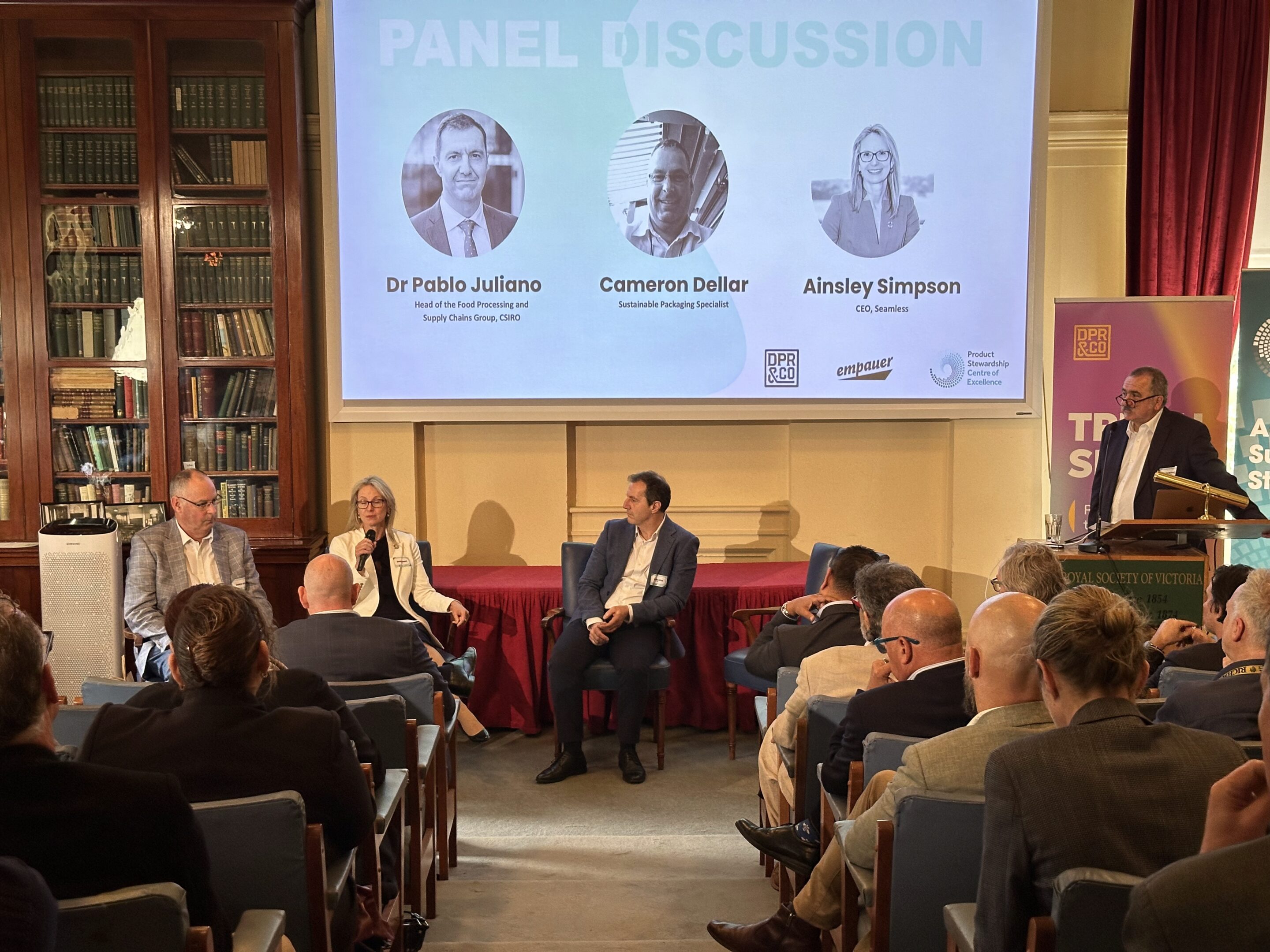
DPR&Co’s recent symposium revealed why being “new and true” is the formula that matters for sustainability communications.
On October 23rd, DPR&Co partnered with Empauer and the Product Stewardship Centre of Excellence to host a groundbreaking symposium at Melbourne’s Royal Society of Victoria. The event brought together some of Australia’s leading voices in sustainability communications, from CSIRO researchers to industry leaders, to tackle a critical question: how do we communicate sustainability in ways that drives consumer action? It turns out the answer is both simpler and more difficult than most businesses realise.
The Say-Do Gap is real (and it’s costing you)
DPR&Co Co-founder Richard Ralphsmith opened with a sobering insight that should concern every marketer: 69% of customers tell us they care about sustainability in their grocery choices. But when it comes to the checkout, how many of them are delivering on that promise? 8%.
This “Say-Do Gap” exists across every category. Consumers are simply not making sustainable purchases at anything like the rates they are telling us in research groups. And when they have to pay a premium for sustainability, the gap is even wider.
But while customers may not reward you for your sustainable practices, they will absolutely punish you when you fail to live up to your promises. Ralphsmith cited Deutsche Bank, Nestlé and Volkswagen as cautionary tales of the cost of businesses who have suffered hundreds of millions of damage due to, he quipped, “consumer goodwill impairments.”
The New Truth®: your path forward
So how do you effectively sell sustainability? Ralphsmith offered the industry leaders two words to judge the likely success of any sustainability initiative: new and true. Your messages must be both in order to work.
Neuroscience research into our Reticular Activating System shows that our brains are hardwired to ignore familiar messages and respond to novel stimuli. “That’s why you cannot bore anybody into buying anything,” said Ralphsmith.
But novelty without authenticity is counterproductive. Once more citing neuroscience, he said “If your consumers receive a message that doesn’t strike them as true, it will be immediately dismissed as insincere, wacky, gratuitous or irrelevant.” The solution? “Develop a single statement of what is new and true about your brand’s value to your audience. That statement has to be new and it has to be true.”
This New Truth® then forms the foundation of your marketing efforts.
From complexity to clarity
This notion was reinforced throughout the symposium. Professor Simon Lockrey from RMIT urged embracing complexity in the data while insisting on simplicity in messaging, pointing to the $121 million End Food Waste CRC’s success in “direct messaging off the back of embracing real complexity.”
David Robb demonstrated the “new and true” in action, with Mobile Muster’s “however it dies, recycle it” campaign achieving 68% awareness while maintaining rigorous fact-checking. “The messaging needs to be engaging, but it needs to be fact-based and demonstrable with data,”
Meanwhile, Milliken’s Shaneel Deo showcased how transparency builds trust, revealing their entire manufacturing process for Renashi, a revolutionary flooring product made from 80% carpet waste and 20% soft plastics.
The Verdict
For CMOs navigating sustainability communications, the symposium’s message was unequivocal: persuasion happens at an emotional level, but it must be anchored in verifiable truth. As Ralphsmith concluded, “Our task is not to inform consumers about our sustainability credentials. It’s to persuade them.”
The question isn’t whether your organisation can afford to be new and true. It’s whether you can afford not to be.
Symposium Videos:
All speakers:
Professor Simon Lockery:
Richard Ralphsmith:
Shaneel Deo:
David Robb: